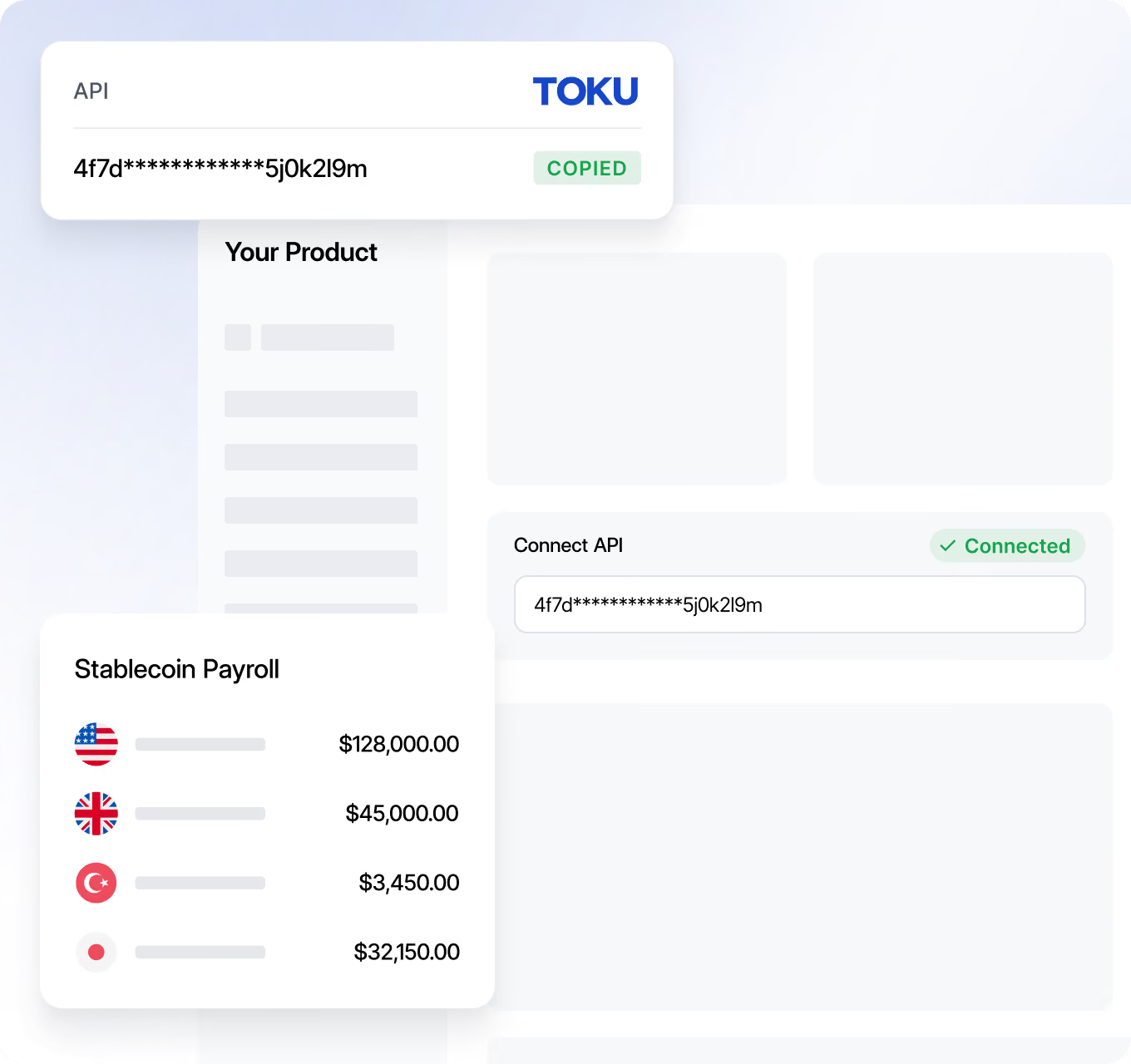
Headless Payroll API

Run payroll through your own product

A headless payroll API lets you run payroll programmatically through your own systems instead of a packaged dashboard. You control the interface and the workflow. Toku runs the engine, the compliance, and the global settlement underneath.

Time to first run
Days
to weeks
Integrations to build
One
for the full stack
Compliance you maintain
Zero
provider-owned
What it is

Payroll as programmable infrastructure, not a dashboard.

A headless payroll API separates the payroll engine from the interface. Instead of logging into a vendor's dashboard, your own application calls an API to create workers, run pay cycles, move funds, and pull reporting. Toku handles the parts that are hard to operate at scale, and you keep control of the experience your team and your contractors actually touch.

What it does. Your application calls the API to create workers, run pay cycles, move funds, and pull reporting. Funds settle globally in digital dollars for near-instant payout, then convert to local currency through a single transparent off-ramp. Toku owns the tax filing and the rule changes.

What it doesn't do. A headless API is not a decision to outsource judgment. Confirm where the compliance line sits before you choose. A data API moves information but may leave filing with you. A full payroll layer takes on tax filing, withholding, and remittance. Buying also costs you some control: you inherit a provider's model of how payroll works and depend on its coverage and roadmap.

Who it's for. Finance and engineering teams that need global payroll reach without carrying compliance in-house. Build in-house only when payroll is the product you sell, or when your requirements are genuinely impossible to meet with an existing layer and you can staff compliance for years.

Control
You own the interface and the workflow your team and contractors touch.
Engine
Toku runs the payroll engine underneath the API.
Compliance
Tax filing, withholding, and regulatory change are owned by the provider behind the API.
Reach
Global disbursement, yield on payroll float, and Visa card issuance through one integration.
How it works

Extend the system you already run.

STEP 01
Keep your system of record
Your existing payroll system stays in place and keeps owning your employees and the core run.
STEP 02
Call the API 
Your application creates workers, runs pay cycles, and moves funds programmatically. No packaged dashboard in the way.
STEP 03
Toku settles and files
Funds settle in digital dollars for near-instant global payout, then convert to local currency through a transparent off-ramp. Toku owns filing and withholding.
STEP 04
Write back to your records
Results write back to your system of record so your books stay whole. No parallel source of truth to reconcile.
Yield powered by Paxos Labs and Morpho

Pick the risk profile that fits your treasury policy.

Toku Yield offers programs across a risk spectrum, powered by Paxos Labs and Morpho. Both deploy your float transparently, name the underlying yield source, and are operated by audited partners. Choose the one your finance team is comfortable with.

Conservative
Treasury-backed yield
Deploys stablecoins into tokenized assets that generate yield from US government Treasury bills. The most conservative program. Assets are only deployed into highly trusted vehicles such as Paxos' USDG and Superstate's USTB.
Yield sourceUS Treasury bills
VehiclesUSDG · USTB
Core
On-chain lending yield
Generates yield from on-chain lending markets that are highly vetted, managed by trusted counterparties, and accept blue-chip collateral such as BTC and ETH. Middle of the risk spectrum.
Yield sourceVetted lending markets
Powered byMorpho
Frontier
Extended-collateral yield
Generates yield from on-chain lending markets that accept additional collateral assets outside BTC and ETH, including derivative assets. Higher potential yield, wider collateral set than Core.
Yield sourceExtended-collateral markets
Powered byMorpho
Important — please read

Yield services provided by Paxos Labs. Rates are variable and subject to change. Stablecoins deposited into yield programs are held by Paxos Labs and are not FDIC insured. Past performance does not guarantee future results.

Toku is not a bank, broker-dealer, or investment adviser. Funds held in yield-bearing instruments may lose value. Consult your financial adviser before making decisions based on yield projections. Toku provides compliance infrastructure and is not a law firm; this content does not constitute legal or tax advice.

Why it matters

Why teams embed instead of build.

// 01
The code is the cheap part
A team can prototype payroll in a sprint. It works in one country, one currency, one set of rules. The cost starts the moment the second country arrives.
// 02
Compliance is a standing liability
Withholding logic, tax filing, classification rules, security, and audit are owned, monitored, and updated for the life of the system. None of it ships once.
// 03
Time to first run collapses
Building reaches a first payroll run in quarters. Embedding an existing layer reaches it in days to weeks.
// 04
Keep what already works
Extend your system of record instead of replacing it. You avoid a migration and add only the reach you are missing.
// 05
Rule changes stop pulling your roadmap
When a tax authority changes a withholding rate mid-year, it is the provider's problem, not a week off your engineers' sprint.
// 06
Global payment without the rebuild
Add international contractors and instant global settlement that a domestic payroll tool was never built to handle.
The decision

Build, buy, or extend: which fits your team?

Most build-vs-buy guides stop at two options and miss the one that fits most teams. You do not have to choose between building payroll from scratch and ripping out the system you already run.
Factor
Build in-house
Buy a full platform
Embed a headless API
Time to first payroll run
Quarters
Weeks
Days to weeks
Engineering cost
High, ongoing
Low
Low to moderate
Who owns compliance
You, forever
The platform
The provider behind the API
Ongoing maintenance
Continuous
Vendor-managed
Vendor-managed
Control over workflow
Total
Limited
High
Keep your current system of record
No
Usually replaced
Yes
Best fit
Payroll is your product
Starting fresh, want one tool
Have a stack that works, need new reach
Use cases

Where yield matters most to your team.

Competing for
Global Talent
Companies hiring contractors and employees across markets where rate negotiation is tight and every basis point of compensation matters.
Recipients earn yield on the balance they hold between paydays. The total economic value of accepting work from you goes up, without you changing the rate you pay.
Contractors Holding Balances Between Projects
Contractors who get paid in lump sums and hold the balance for weeks or months before spending or off-ramping it.
The held balance earns yield instead of sitting idle in a wallet. Most impactful for contractors with irregular pay cycles or larger per-project payments.
Employees in Markets with Limited Local Banking
Employees in regions where local savings products are limited, inflation-eroded, or hard to access. The Rain Card already gives them spending access; yield is the next layer.
Recipients earn yield on the same balance they spend from. No second account, no transfer between savings and spending. A single wallet that holds, earns, and spends.
FAQ

Common questions about the payroll API.

What is a headless payroll API?
A headless payroll API is payroll delivered as programmable infrastructure rather than a packaged dashboard. Your own application calls the API to create workers, run pay cycles, move funds, and pull reporting, while the provider operates the payroll engine and the compliance underneath. You control the interface and the workflow. The provider owns the parts that are hard to run at scale.
Should I build or buy a payroll API?
Build only if payroll is the product you sell, or your requirements are genuinely impossible to meet with an existing layer and you can staff compliance for years. For nearly everyone else, buy or embed. The deciding factor is rarely the code. It is whether you want to own tax filing, withholding rules, and regulatory change for the life of the system.
How much does it cost to build payroll in-house?
The build is the smaller, predictable cost: engineers and a few months. The larger cost is permanent. It includes multi-country tax filing, withholding maintenance as rules change, classification logic, security and audit, and ongoing engineering pulled off your roadmap to keep the system legal. The total is dominated by maintenance, not by the initial build.
What does a payroll API not handle for me?
That depends on whether it is a payroll-data API or a full payroll engine. A data API connects to systems and moves information, but you may still own compliance and filing. A full payroll layer takes on tax filing, withholding, and remittance. Confirm where the compliance line sits before you choose, because that line is the entire point of buying.
Can I add a payroll API without replacing my current system?
Yes. This is the extend model. Your existing system of record keeps running domestic payroll, and an API layer adds the capability it lacks, such as paying international contractors or settling globally in near-instant time. You avoid a migration and only add the missing reach. For many teams this is the lowest-risk path to global payment.

Map it to the stack you already run.

Bring your current system of record. The team will walk through what embedding global payroll and settlement looks like through the API, without a rebuild.

DISCLAIMERS
Toku provides compliance infrastructure and is not a law firm. This content is for informational purposes only and does not constitute legal or tax advice. Consult your legal counsel for jurisdiction-specific guidance.
Yield is variable and not guaranteed. Past performance is not indicative of future results. Toku is not a bank, broker-dealer, or investment adviser. Funds held in yield-bearing instruments are not FDIC-insured and may lose value. Consult your financial adviser before making decisions based on yield projections.