A defined engagement model
Toku acts as agent of record, with AOR contracts and compliance review scoped to your contributor program.
3 months of Toku EOR fees on usSee limited time offer
Agent of Record · For ecosystem and program operations
When contributor agreements, invoices, and payouts live in different places, every program cycle creates more coordination. Bring them together with Toku as your agent of record.
Trusted by teams using Toku


Contractor operations
A modern AOR designed for global teams, digital-asset compensation, and international contractor compliance.
Toku acts as agent of record, with AOR contracts and compliance review scoped to your contributor program.
Coordinate contributor invoices and high-volume stablecoin payouts under one program workflow.
Give finance, HR, and legal detailed program reporting instead of assembling records from separate payment tools.
How it works
Review the engagement model, contributor onboarding, approvals, and reporting before the first payment run.
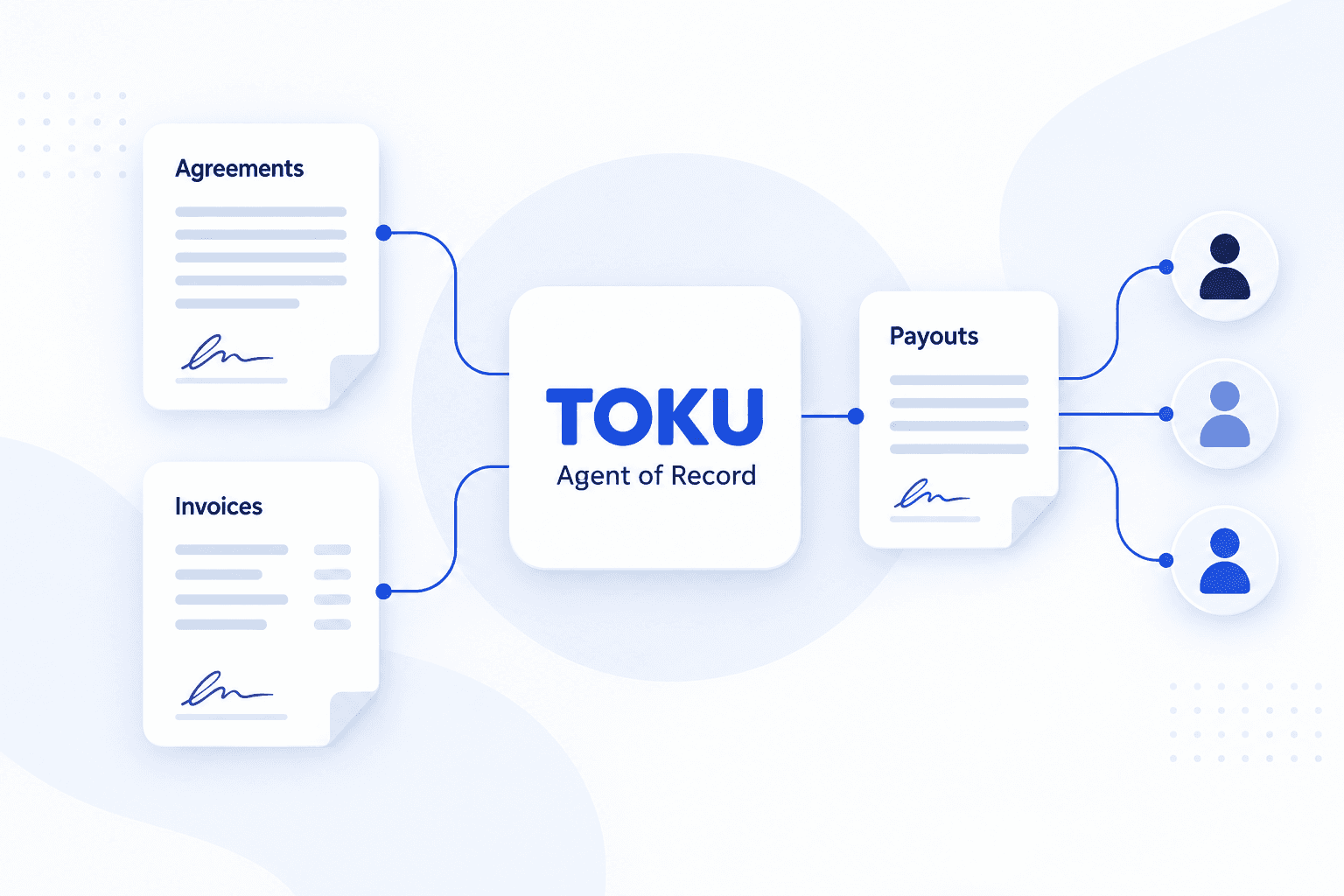
Review contributor roles, countries, volumes, and payment types. Confirm the AOR contract and responsibilities before onboarding.
Collect contributor information and required documentation, then coordinate invoicing, approvals, and funding. The first usable record is the contributor agreement and onboarding file.
Run contributor payouts and keep the associated reports available for finance, HR, and legal. Use each cycle to replace repeated manual handoffs.
Built for your team
Toku’s Agent of Record supports teams that need compliant international contractor engagement without operational overhead.
Coordinate recurring contributor engagements and payment records across your ecosystem.
Give program operations a consistent process for agreements, onboarding, and payouts.
Review the engagement model and reporting requirements before committing to a launch date.
Plan for your countries, contributor volume, and stablecoin or token mix.
Pricing
For teams that need compliant contractor engagement, classification protection, and cross-border payout flexibility.
Starting at $149
Per contractor / month
What’s included
What your quote depends on
Use cases
Simplify contractor management, reduce risk, and support digital-asset compensation.
For companies engaging distributed contributors across LATAM, APAC, Europe, and high-risk jurisdictions like California.
Toku handles onboarding, compliant AOR agreements, contractor classification, tax documentation, and payouts in fiat or stablecoins - all from one system.
For companies running ambassador networks, creator programs, community bounties, or research initiatives.
Toku centralizes KYC/AML, contracting, and recurring payouts (fiat or stablecoins) while maintaining audit-ready reporting for finance, HR, and legal.
For teams combining fiat payroll, contractor engagements, token grants, and stablecoin payouts.
Toku connects employment data, token events, and contractor payments into one compliant workflow - no custom spreadsheets, manual CSVs, or wallet-by-wallet management.
Payment flexibility
Toku pays contractors in USDC and USDT, plus USDG and RLUSD. Each contractor chooses what they receive — stablecoins to a wallet, or local currency to a bank account. Confirm available currencies, countries, funding cutoffs, and recipient timing for your payment route.
Choose the relationship
AOR is for programs that need Toku to act as agent of record. Contractor Management supports your company’s direct contractor relationships with onboarding, invoice approvals, payments, and ledgers.
Explore Contractor ManagementConfirm the legal and operational scope for your program. The AOR model does not make every engagement suitable or remove all classification risk.
Prepare the first program review
Review contributor roles and countries, existing contracts, approval owners, payment frequency, funding source, and reporting requirements. Confirm the agreement and onboarding requirements before committing to the first payout date.
For your internal discussion: we’re evaluating an agent of record to connect contributor contracts, centralized invoicing, and program payouts, with reporting for finance and legal.
These customers describe their broader experience with Toku’s global hiring and payment services.
“Toku is the obvious choice for any global crypto company to work with to hire and compensate their employees.”
“We’ve worked with pretty much every EOR in the industry. They’ve all raised hundreds of millions of dollars but have no idea how to work with crypto companies or how to handle tokens. We love working with Toku because they just get it and they care.”
An agent of record (AOR) supports contractor or contributor engagements under the agreed agency model. An employer of record (EOR) legally employs the worker and handles local employment administration. Choose the service based on the actual working relationship and local requirements.
When comparing AOR vs EOR, confirm who signs the agreement, which party is responsible for payroll or invoices, and what classification review and liability coverage are included. An AOR label does not make an employee an independent contractor.
| What to compare | Agent of record (AOR) | Employer of record (EOR) |
|---|---|---|
| Who employs the worker? | The worker remains an independent contractor; the AOR acts under an agency agreement. Confirm the principal and contracting parties. | The EOR is the legal employer. Your company directs the employee’s day-to-day work. |
| Who pays? | Your company funds the contractor’s compensation. The AOR administers invoices and payouts within its agreed scope. | Your company funds salary, employer costs and service fees. The EOR runs payroll and handles required deductions and remittances. |
| Risk and responsibility | Classification depends on the actual working relationship and local law. Review the agency authority, liability limits and any indemnity; AOR does not eliminate misclassification risk. | The EOR takes on employer obligations under the local arrangement. Your company still has responsibilities; confirm coverage, exclusions and the division of duties. |
| Cost | Budget for contractor compensation, the AOR service fee and any payment or currency-conversion charges. | Budget for gross salary, employer contributions, benefits, the EOR service fee and any deposits or one-time charges. |
| When to use each | For genuinely independent work where you need an agency model for contractor onboarding, documentation and payments. | For a role that requires employment in a country where you need a local employing arrangement. |
Compare current Toku pricing and request an itemized quote for the country and role. Service fees alone do not represent the total cost.
Choosing support for a small team? Read our PEO vs contractor of record guide for small businesses to compare responsibilities, costs and fit.
For employee hiring, explore employer of record services. For independent engagements, compare the contractor of record model.
See Toku in action
Review the engagement model, onboarding, payment cycle, and reports with your operations and finance teams.