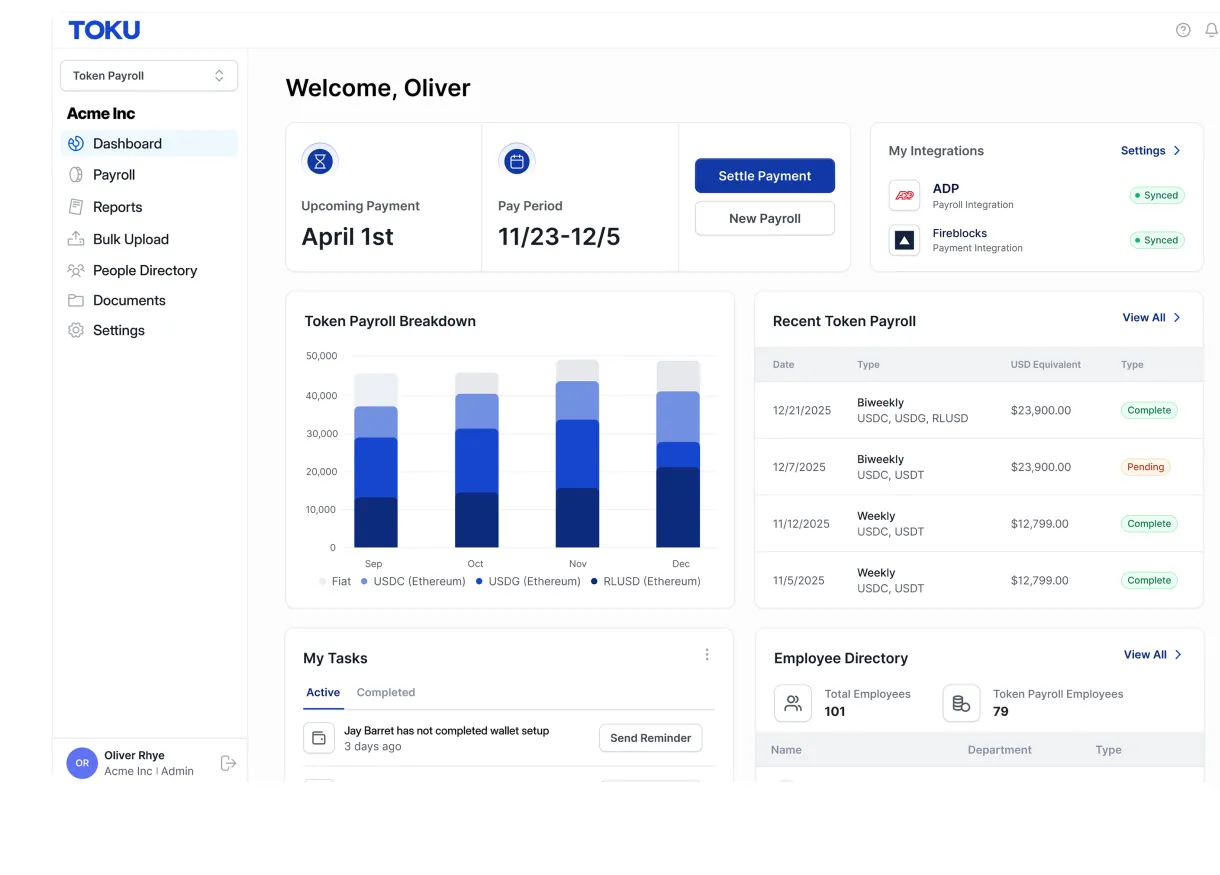
ADP runs fiat payroll at enterprise scale. Toku adds stablecoin payroll on top.
ADP has processed payroll since 1949 and serves over one million businesses in 140+ countries. It is not built for stablecoins, token grants, or on-chain settlement — and it does not need to be. Toku integrates directly with ADP, adding compliant stablecoin payroll and global EOR without touching your existing workflows.
Toku
Stablecoin payroll and EOR layer
Connects to ADP via API. Adds stablecoin settlement on Polygon, Sei, Ethereum, Solana and other token networks, token grant management, and EOR in 100+ countries - without replacing ADP as your system of record
ADP
Enterprise fiat payroll and HCM
Global fiat payroll in 140+ countries, US and international tax filing, time tracking, benefits, and workforce analytics for companies that have established legal entities in each country they operate in
What Toku adds to ADP
The stablecoin layer ADP does not have
ADP handles your fiat payroll. Toku sits underneath it as the stablecoin settlement and global EOR layer, reading approved payroll data from ADP and executing on-chain payments without any duplicate data entry or workflow disruption.
Stablecoin payroll in USDC, USDT, USDG, PYUSD, and fiat
Pay employees in major stablecoins or fiat, or split between the two per worker. Tax withholding, compliant payslips, and reporting are included in every payroll cycle.
Instant on-chain settlement via multiple token networks
Where ADP moves money through correspondent banks in 3 to 5 business days, Toku settles on-chain in minutes. Sub-cent transaction fees. Available 24/7, including weekends and public holidays.
Private stablecoin payroll via Aleo and Paxos Labs
Salary data stays off public ledgers. Every transaction is confidential on-chain — the feature built specifically for CFOs who want stablecoin payroll without making their compensation data public.
Token grants, vesting schedules, and TGE management
ADP has no token compensation module. Toku handles the full lifecycle: grant agreements, vesting schedules, automated distributions, and jurisdiction-aware tax reporting, running alongside regular payroll.
Global EOR
EOR in 100+ countries without a local entity requirement
ADP Global Payroll requires a local legal entity in each country. Toku's EOR service employs workers on your behalf, so you can hire globally without entity setup, and pay them in stablecoins or fiat from day one.
Stablecoin pay direct to UR accounts with Mastercard spend
Employees receive stablecoin pay into a UR account and spend it via Mastercard anywhere in the world. They can also transfer via SEPA or SWIFT, or convert to fiat. No crypto knowledge required.
What ADP does well. What it does not do.
ADP is one of the most trusted payroll platforms on the planet. That is not the question. The question is whether it covers what your team needs in 2026.
Stablecoin settlement is the foundation
Toku was built to move payroll money on-chain. That means instant settlement on multiple token networks, private payroll via Aleo and Paxos Labs, and funding via Mesh's network of 300+ exchanges and wallets. For workers in markets with unreliable banking infrastructure, USDC arriving in minutes is not a feature — it changes whether they can pay rent on payday.
Hire anywhere without a local entity
Toku's EOR service covers 100+ countries. You hire the employee, Toku employs them legally on your behalf and handles payroll, tax, and statutory benefits in their country. There is no need to incorporate locally first. This matters especially for crypto and Web3 companies whose teams are distributed across markets where entity setup would take months and cost tens of thousands of dollars.
Token compensation built into payroll
Teams that issue token grants alongside salary cannot manage this in ADP. Toku handles the full token compensation lifecycle — grant agreements, vesting schedules, automated distributions at each cliff, and jurisdiction-aware tax reporting — running in the same platform as stablecoin and fiat payroll. ZKsync, Protocol Labs, Gnosis, and Astar Network run this in production today.
Bank rails, built for a different era
ADP GlobalView and ADP Celergo are among the best-regarded multi-country fiat payroll platforms in enterprise. They are also built on SWIFT and ACH, which means 3 to 5 day settlement windows, per-transaction bank fees, and no path to on-chain execution. ADP's own research describes blockchain in payroll as a future possibility, not a current product. As of Q1 2026, ADP has no stablecoin payroll offering.
Global payroll for companies that already have entities
ADP Global Payroll is designed for large multinationals that have already established legal entities in their operating countries. It consolidates payroll processing across those entities into one platform. If you do not have a local entity, ADP is not the answer — you need an EOR solution first. ADP does offer some EOR capabilities, but its core product is entity-led payroll, not EOR-led hiring.
Deep HCM capabilities for large enterprises
Where ADP genuinely leads is in the breadth of its human capital management suite. Time tracking, workforce analytics via ADP DataCloud, US benefits administration, performance management, and compliance tools across 140+ countries — all under one platform that has been refined over decades. For a 5,000-person multinational with existing entities, ADP's depth is hard to replicate.
Toku vs ADP: a side-by-side breakdown
Based on publicly available product information as of Q1 2026.
| Capability | Toku | ADP |
|---|---|---|
| Stablecoin and Crypto Payments | ||
| Stablecoin payroll (USDC, USDT, USDG) | Core product, production-ready | No stablecoin payroll as of Q1 2026 |
| On-chain settlement networks | Polygon and Sei | Not applicable; fiat rails only |
| Private stablecoin payroll (confidential on-chain) | Via Aleo and Paxos Labs | Not available |
| Stablecoin pay connected to banking and spend card | Via UR Mastercard integration | Not available |
| Token and equity grant management | Vesting, grants, TGE, reporting | Not available |
| Payroll Infrastructure | ||
| Multi-country fiat payroll | 100+ countries | 140+ countries (requires local entity) |
| Global EOR (hire without a local entity) | 100+ countries | Limited EOR; ADP Global Payroll requires own entities |
| Tax withholding and compliant payslips | All payroll jurisdictions | All payroll jurisdictions |
| Integration with existing HRIS and payroll systems | Connects to ADP, Workday, Gusto, UKG, SAP | Integrates with SAP, Oracle, Workday, and others |
| US benefits administration (health, 401k) | Not a core offering | Full US benefits suite |
| Workforce analytics and reporting | Payroll and compliance reporting | ADP DataCloud; advanced workforce analytics |
| Dedicated implementation lead | Named lead per customer | Account management; implementation typically 6+ months |
| Pricing transparency | Discussed directly with Toku team | Quote-based; per-employee fees, module costs, and setup fees vary |
| SOC compliance | SOC 2 certified | SOC 1 and SOC 2 certified |
Based on publicly available product information as of Q1 2026. Toku makes no representations as to the completeness or accuracy of ADP product information on this page.
| Toku | ADP (RUN / Workforce Now) | |
|---|---|---|
| Pricing Model | ||
| Base pricing | Custom per worker Itemized invoice One platform fee per worker; all rails included | ~$79/mo + $4–6/employee RUN Essential; ADP does not publish full pricing — quote required. Hidden fees common. |
| Implementation / setup fee | ✓ No setup fee Zero | ✗ ~$2,000 typical One-time onboarding and setup fee reported by users |
| Pricing transparency | ✓ Platform + employer costs + on-chain fees itemized Fully visible | ✗ Quote-only; add-ons inflate cost ADP charges separately for tax filing, reporting, year-end, multi-state. Hidden fees common. |
| Stablecoin & Crypto Support | ||
| Stablecoin payroll | ✓ Included — every plan Core feature Instant USDC payouts; sub-cent gas fees; 100+ countries | ✗ Not available ADP processes payroll in fiat only — no stablecoin support |
| Token grant administration | ✓ Vesting, cliff, tax reporting — native Unique capability | ✗ Not available |
| Cross-border transaction costs | <$5 total (batch) vs. 6.5% avg Stablecoin on Polygon eliminates wire fees and FX spreads | FX markup + wire fees Traditional wire rails; 1–5% FX spread; $10–25/transfer typical |
| Integration Relationship | ||
| ADP integration | ✓ Toku integrates with ADP Keeps ADP as source of truth Your ADP workflow stays unchanged — Toku adds stablecoin rails behind it | ~ ADP is the platform ADP does not natively support stablecoin outputs; would require a custom build or third-party integration |
| Global Coverage | ||
| Countries (payroll) | 100+ Full compliance + stablecoin in every country | 140+ (via partner network) ADP GlobalView for enterprise global payroll — fiat only |
| Payroll run fees | ✓ No per-run charge Unlimited runs | ~ Charges increase with frequency ADP RUN charges per payroll run above the monthly base on some plans |
Making the Right Choice
Which platform fits your team?
Add Toku if...
You run ADP and need stablecoin payroll or global EOR
- You want to pay employees in stablecoins without migrating off ADP
- You issue token grants or manage vesting schedules alongside salary
- You are hiring employees in countries where you do not have a local entity
- Cross-border payment speed and cost are genuine operational problems for your team
- Your CFO wants stablecoin payroll but needs salary data off public ledgers
- You want workers to receive pay instantly, including on weekends and holidays
ADP alone may be sufficient if...
Your payroll is fiat-only and entity-led
- You have legal entities in every country where you pay employees
- Stablecoin payroll is not a current or near-term requirement
- You need deep US benefits administration, time tracking, and workforce analytics
- You are a large enterprise (1,000+ employees) consolidating from multiple regional payroll providers
- Your team does not issue token compensation or equity grants
- A 6-month implementation timeline is acceptable for your rollout
Toku vs ADP: questions finance teams ask
Ready to Switch from ADP?
Run compliant global payroll on stablecoin rails with Toku.