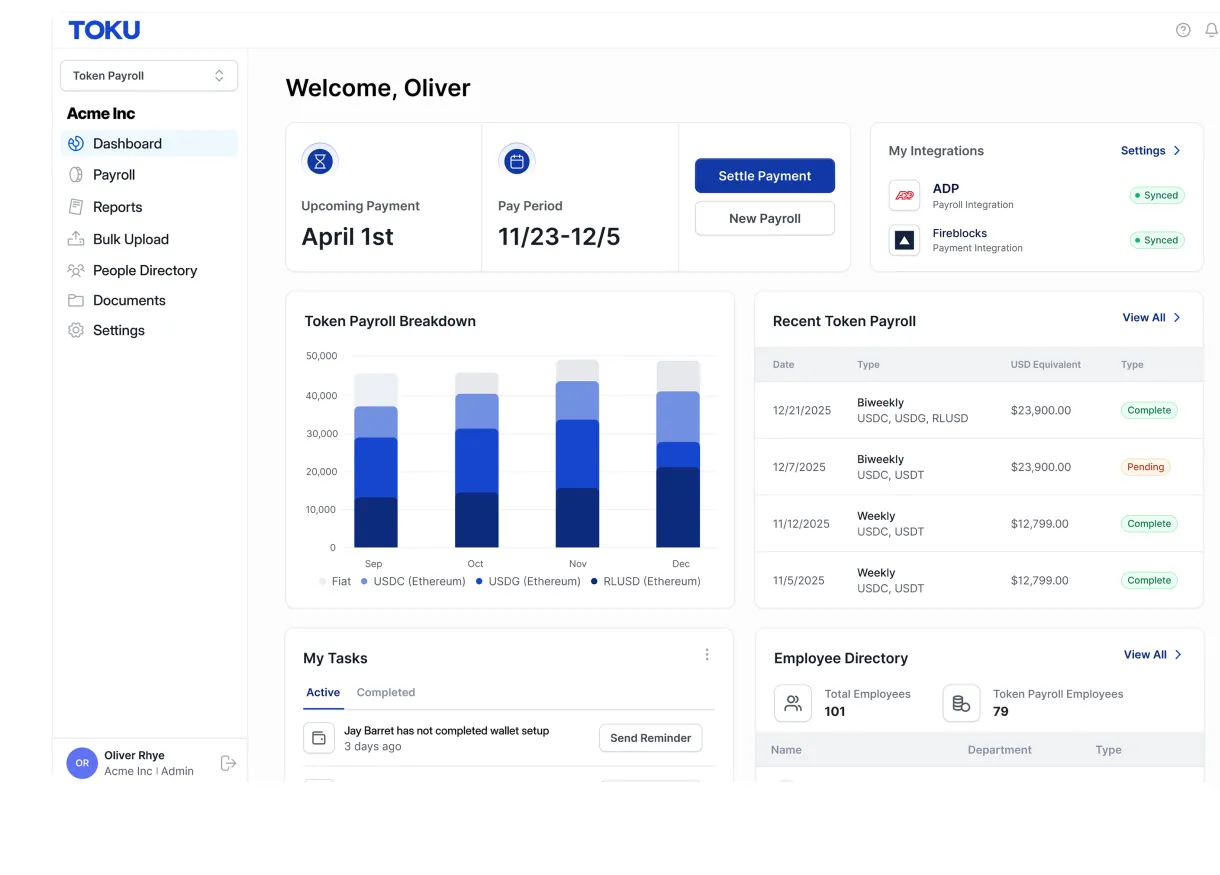
G-P built the EOR industry. It wasn't built for stablecoin payroll.
G-P is the compliance gold standard for global hiring owned entities in 180+ countries, deep legal infrastructure, and more than a decade of EOR experience. Toku covers 100+ countries for EOR and adds what G-P doesn't offer: stablecoin payroll, token grant management, and on-chain settlement. If your compensation model goes beyond fiat, that gap is the deciding factor.
Toku
Stablecoin payroll and EOR
EOR in 100+ countries, stablecoin settlement on multiple token networks, token grant management, private payroll via Aleo and Paxos Labs, and integration with existing HRIS systems
G-P
Enterprise EOR pioneer
EOR in 180+ countries, contractor management, global payroll, AI-powered compliance via G-P Gia™, immigration services, and the deepest in-country legal expertise in the market. No stablecoin payroll or token compensation
What Toku offers
EOR plus stablecoin payroll in one platform
Toku starts where G-P stops. The EOR capability is comparable. What follows the hire — how workers get paid and in what currency — is where the platforms diverge entirely.
Stablecoin payroll in USDC, USDT, USDG, PYUSD, and fiat
Pay employees in stablecoins or fiat, or a split of both per worker. Tax withholding, compliant payslips, and reporting included in every cycle, in every jurisdiction.
Instant on-chain settlement via token networks
G-P pays via traditional banking rails, which means 3 to 5 day settlement windows and FX markups. Toku settles on-chain in minutes at sub-cent cost, 24/7.
Private stablecoin payroll via Aleo and Paxos Labs
For teams where salary transparency on public ledgers is a blocker, Toku's private stablecoin payroll keeps every transaction confidential on-chain using zero-knowledge technology.
Token grants, vesting schedules, and TGE management
Token compensation does not exist in G-P. Toku handles grant agreements, vesting cliffs, automated distributions, and jurisdiction-aware tax reporting alongside regular payroll.
Banking access
Stablecoin pay direct to UR accounts with Mastercard spend
Employees receive stablecoin pay into a UR account, integrate into any wallet in any neobank, and spend via Mastercard globally, or transfer via SEPA or SWIFT. No crypto knowledge required on the employee side.
Connects to ADP, Workday, Gusto, UKG, and SAP
Toku integrates underneath your existing payroll systems. If you already run G-P for EOR compliance, Toku adds stablecoin rails via API without requiring a migration or workflow change.
Two global EOR platforms. Different answers to the same question.
Both platforms solve the "hire without a local entity" problem. Where they diverge is on everything that happens after the offer letter is signed.
Stablecoin payroll from day one
Every employee hired through Toku's EOR can be paid in stablecoins, fiat, or a combination of both. The payment rail is on-chain which means instant settlement, sub-cent transaction costs, and no correspondent banking delays. This is built into the platform, not available as an add-on or a partner integration.
Token compensation built into the platform
Teams that compensate employees with token grants alongside salary need a platform where both live together. Toku manages the full token compensation lifecycle — grant agreements, vesting schedules, automated cliff distributions, and jurisdiction-aware tax reporting — within the same platform that handles stablecoin and fiat payroll. ZKsync, Protocol Labs, Gnosis, and Astar Network use this in production.
Integrates underneath existing payroll infrastructure
If your team already runs ADP, Workday, Gusto, or another HRIS — or uses G-P for EOR compliance — Toku connects via API and adds stablecoin rails without requiring a platform switch. For companies with established payroll infrastructure who want to add global stablecoin capability, Toku's integration model avoids the migration overhead that a full platform switch involves.
Fiat payroll via traditional banking rails
G-P pays employees through conventional banking infrastructure. As of Q1 2026, G-P has no stablecoin payroll capability and relies exclusively on traditional banking rails for employee and contractor payouts. For teams whose workers expect or need stablecoin compensation, G-P cannot deliver that today.
AI-powered compliance with G-P Gia™
G-P Gia is G-P's agentic AI compliance advisor — it generates HR documents, runs end-to-end compliance checks, monitors policy changes across jurisdictions in real time, and alerts teams to issues before they become problems. For enterprises that need automated compliance management at scale, Gia is a meaningful capability that Toku does not offer.
Coverage depth and owned-entity footprint
G-P covers 180+ countries with owned entities in approximately 125 active markets — the largest owned-entity footprint in the EOR industry. For companies hiring in unusual jurisdictions, managing complex termination scenarios, or navigating heavily regulated industries like financial services or energy, G-P's in-country legal team is a genuine advantage. Toku operates across 100+ countries, purpose-built for the crypto-native and globally distributed team segment.
Toku vs G-P: a side-by-side breakdown
Based on publicly available product information as of Q1 2026.
Stablecoin and crypto payments
| Feature | Toku | G-P |
|---|---|---|
| Stablecoin payroll (USDC, USDT, USDG) | Core product, production-ready | No stablecoin payroll as of Q1 2026 |
| On-chain settlement networks | Any network including Polygon, Ethereum, Solana and Sei | Traditional banking rails only |
| Private stablecoin payroll (confidential on-chain) | Via Aleo and Paxos Labs | |
| Stablecoin pay connected to banking and spend card | Via UR Mastercard | |
| Token and equity grant management | Vesting, grants, TGE, reporting |
Global employment
| Feature | Toku | G-P |
|---|---|---|
| Employer of record (EOR) | 100+ countries | 180+ countries |
| Contractor management | Alongside employee payroll | Supported |
| US PEO services | Available | Available |
| Onboarding speed | Fast onboarding, dedicated implementation lead | Named account manager, guided onboarding |
| AI-driven HR compliance advisor | G-P Gia™ — document generation, policy monitoring | |
| Immigration and visa services | Add-on available | |
| Tax withholding and compliant payslips | All payroll jurisdictions | All EOR jurisdictions |
| Multi-currency fiat payroll | ||
| Integration with major HRIS platforms (ADP, Workday) | Native API integrations | Native integrations |
| SOC 2 certification | SOC 2 certified | SOC 2 certified |
Based on publicly available product information as of Q1 2026. Toku makes no representations as to the completeness or accuracy of G-P product information on this page.
| Toku | G-P (Globalization Partners) | |
|---|---|---|
| EOR Pricing | ||
| EOR service fee | Custom per worker No hidden extras Flat platform fee per worker; stablecoin rails included | $599–$1,000+/employee/mo Quote-based; no public pricing; industry estimates $599–$800 standard, $1,000+ for complex markets |
| Pricing transparency | ✓ Itemized invoice Transparent Platform fees + employer costs + on-chain fees all listed | ✗ Quote-only G-P requires a sales conversation before disclosing any pricing |
| Setup / implementation fees | ✓ None — API drop-in No setup cost | ✗ $10,000–$50,000+ For custom HRIS/ERP integrations at enterprise deployments |
| Minimum contract commitment | ✓ Flexible No minimum headcount requirements reported | ~ Annual contracts typical G-P often requires annual contracts with minimum headcount — pay for unused seats |
| Stablecoin & Crypto Payroll | ||
| Stablecoin payroll | ✓ Included in every plan Core — not an add-on USDC on Polygon; instant settlement; $1B+ annual volume | ✗ Not offered G-P is a traditional EOR — no stablecoin or crypto payroll capabilities |
| Token grant administration | ✓ Native Unique to Toku Vesting, cliff logic, TGE support, tax-aware reporting | ✗ Not available G-P has no token equity or Web3 compensation tooling |
| Cross-border fee savings | <$5 total gas fees vs. 6.5% wire avg Polygon rails replace wire transfer fees; batch payouts | Standard wire / FX fees Traditional banking rails; multi-day settlement; FX markups apply |
| Integrations | ||
| Integrates with ADP / Workday / Gusto | ✓ Native — no migration Keep existing stack | ✓ HRIS integrations available G-P integrates with BambooHR, Workday, SAP, ADP — but requires G-P as primary platform |
| Coverage | ||
| Countries | 100+ Full stablecoin compliance in every covered market | 180+ G-P's widest-in-class coverage; 95% through owned entities |
Making the Right Choice
Both platforms are credible options for global hiring. The decision comes down to what your compensation model requires.
Toku is the right fit if...
Stablecoin payroll or token compensation is part of the picture
- You want to pay international employees in stablecoins — not just fiat
- You issue token grants, manage vesting schedules, or run token generation events
- Cross-border payment speed and cost are operational problems you are actively trying to solve
- You want stablecoin payroll that keeps salary data off public ledgers
- You already use ADP, Workday, or Gusto and want stablecoin rails underneath without a migration
- You want employees to receive stablecoin pay and spend it via a Mastercard
G-P may be the right fit if...
Compliance depth and legal certainty come before everything else
- You are hiring in markets outside Toku's current 100+ country footprint
- You operate in regulated industries — financial services, energy, healthcare — with strict employment law requirements
- You need AI-driven compliance monitoring and document generation via G-P Gia™
- Managing executive relocations or complex terminations across multiple jurisdictions is part of your scope
- You are running entirely fiat payroll with no near-term plans for stablecoin or token compensation
Toku vs G-P: questions HR and finance teams ask
Ready to Switch from G-P?
Run compliant global payroll on stablecoin rails with Toku.