Pebl handles traditional global EOR. Toku handles what happens when your team needs stablecoin payroll.
Pebl (formerly Velocity Global) has been running global EOR and fiat payroll in 185+ countries since 2014. It does that well. What it cannot do is stablecoin payroll, token compensation, or on-chain settlement. If your team pays in digital assets or is embedded in a Web3 economy, that gap matters.
Toku
Global stablecoin payroll and EOR with on-chain settlement
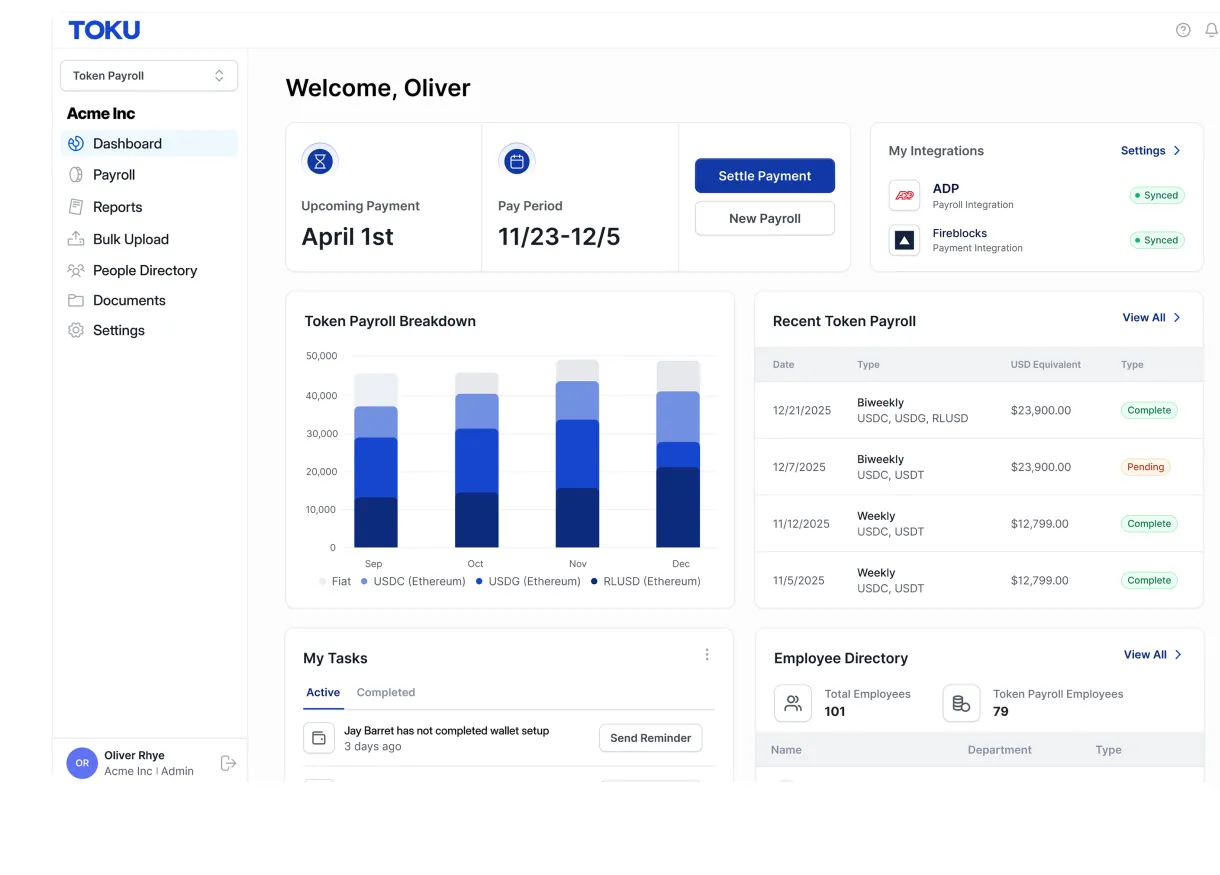
Stablecoin settlement on Polygon, Sei, Ethereum, Solana etc., token grant management, EOR in 100+ countries, and direct integration with existing HRIS platforms — including Pebl — so your traditional EOR workflows remain intact
PEBL
AI-first global EOR and fiat payroll in 185+ countries
Traditional global EOR, multi-country fiat payroll, immigration and visa support, contractor management, and an AI compliance assistant (Alfie). No stablecoin payroll, no on-chain settlement, and no token compensation capability
What Toku adds to Pebl
The stablecoin and token layer Pebl does not have
Pebl runs traditional global EOR and fiat payroll. Toku handles what comes next: stablecoin compensation, on-chain settlement, and token grants. The two platforms connect, so your Pebl setup stays intact.
Stablecoin payroll in USDC, USDT, USDG, PYUSD, and fiat
Pay global employees in stablecoins or fiat, or split between the two per worker. Tax withholding, compliant payslips, and reporting included in every cycle. Pebl handles none of this.
Instant on-chain settlement via token networks
Pebl uses a payroll aggregator model with traditional bank rails. Toku settles on-chain in minutes. No correspondent bank markups, no cut-off windows, no 3–5 day wait for international transfers.
Private stablecoin payroll via Aleo and Paxos Labs
Salary data stays off public ledgers. Transactions are confidential on-chain — addressing the privacy concern that stops most finance teams from moving to stablecoin payroll.
Token grants, vesting schedules, and TGE management
Pebl has no token compensation capability. Toku handles grant agreements, vesting cliffs, automated distributions, and jurisdiction-aware tax reporting alongside regular payroll.
Banking access
Stablecoin pay direct to UR accounts with Mastercard spend
International employees can receive stablecoin pay into a UR account, integrate into any wallet in any neobank and spend via Mastercard anywhere. They can also transfer via SEPA or SWIFT, or convert to local fiat on demand.
Sub-cent on-chain fees vs Pebl's 4% FX markup
Pebl's FX markup is reported at 4% — double the typical 2% industry rate. For a team earning $10,000/month that is $400 per person in overhead. Toku's on-chain settlement eliminates this category of cost entirely.
Where Pebl ends and where Toku begins
Pebl is purpose-built for traditional global EOR and fiat payroll. The moment your team adds digital asset compensation or needs on-chain settlement, you are in territory Pebl does not cover.
Stablecoin payroll that runs today
Toku was built around on-chain settlement. USDC, USDT, USDG, and PYUSD settle in minutes on networks like Ethereum, Polygon, Solana etc. Private stablecoin payroll, via Aleo and Paxos Labs using zero-knowledge technology, keeps salary data off public ledgers entirely. This is not a roadmap item. It is in production and available to Toku customers now — the same day you connect your existing EOR stack.
Own infrastructure; no aggregator markup
Toku operates its own EOR infrastructure across 100+ countries. Stablecoin payments settle directly on-chain — no correspondent banks, no FX intermediaries, no aggregator layers adding markup. For international workers, this means pay arrives in full, in minutes, without a 4% cut disappearing in the middle of the transfer.
Token compensation runs alongside salary
For companies paying teams in a combination of salary and token grants, Toku manages both in one place. Vesting schedules, TGE distributions, and automated tax reporting per jurisdiction run alongside regular payroll. There is no separate tool to reconcile with and no manual process to maintain each cliff date.
No stablecoin payroll as of Q1 2026
Pebl's 2025 rebrand introduced an AI compliance assistant and faster onboarding. Stablecoins and on-chain settlement are not part of that story. Pebl's blog discusses crypto payroll as an industry topic — advising employers on how to pay in crypto — but Pebl itself operates entirely on fiat rails. There is no stablecoin product, no on-chain settlement, and no published roadmap for either.
Aggregator model with a reported 4% FX markup
Pebl is a payroll aggregator — it partners with local payroll providers around the world and centralizes those payments for the client. Independent analysis of Pebl's pricing has noted a reported 4% FX markup on international payments, double the 2% typical of other EOR providers. For a team member earning $10,000 per month, that is $400 per month in FX overhead that Toku's on-chain settlement avoids entirely.
Genuine depth in global compliance and immigration
Pebl (formerly Velocity Global) has over a decade of EOR compliance expertise. Their AI assistant Alfie answers complex HR questions in 50+ languages. Immigration, visa support, and global mobility services are available through one provider. For companies that need enterprise-grade EOR compliance and hands-on immigration help across 185+ countries, Pebl has earned its reputation — and those strengths remain complementary to what Toku does.
Toku vs Pebl: a side-by-side breakdown
Based on publicly available product information as of Q1 2026.
| Capability | Toku | Pebl |
|---|---|---|
| Stablecoin and Crypto Payments | ||
| Stablecoin payroll (USDC, USDT, USDG) | Core product, production-ready | No stablecoin payroll as of Q1 2026 |
| On-chain settlement networks | Polygon, Ethereum, Solana, Sei and many others | Not applicable; fiat bank rails only |
| Private stablecoin payroll (confidential on-chain) | Via Aleo and Paxos Labs | Not available |
| Stablecoin pay connected to banking and spend card | Via UR Mastercard integration | Not available |
| Token and equity grant management | Vesting, grants, TGE, reporting | Not available |
| EOR and Global Payroll Infrastructure | ||
| Global EOR coverage | 100+ countries, Toku-owned infrastructure | 185+ countries; aggregator model with local partners |
| Payroll infrastructure model | Own infrastructure; on-chain + fiat | Payroll aggregator; relies on third-party local providers |
| International contractor management | Supported alongside employee payroll | Agent of Record (AOR) service available |
| Tax withholding and compliant payslips | All payroll jurisdictions | Fiat payroll in covered jurisdictions |
| Immigration and visa support | Not a core offering | Available as add-on; core Pebl strength |
| AI-powered compliance assistant | Not a current feature | Alfie AI assistant; 50+ language compliance answers |
| FX markup on international payments | Sub-cent on-chain fees for stablecoin payroll | Reported 4% FX markup — double industry average |
| Onboarding speed | Named implementation lead per customer | 48-hour onboarding capability; varies by country |
| HRIS and payroll integrations | Connects to Pebl, ADP, Workday, Paychex, SAP | Application Connector Framework; major HRIS supported |
| Pricing transparency | Discussed directly with Toku team | From ~$399/employee/month; true cost often higher after add-ons |
| SOC 2 certification | SOC 2 certified | SOC 2 and ISO 27001 certified |
Based on publicly available product information as of Q1 2026. Toku makes no representations as to the completeness or accuracy of Pebl product information on this page.
| Toku | Pebl (formerly Velocity Global) | |
|---|---|---|
| EOR Pricing | ||
| EOR per employee/month | Starting at $299 Stablecoin included All rails (fiat + stablecoin + token) included in worker fee | From $399–$599/employee/mo Promotional rate from $399; standard rate $599/mo. Quote-based. Pebl rebranded from Velocity Global in Sept 2025. |
| Pricing transparency | ✓ Full itemization No hidden extras Platform fee + employer costs + on-chain fees all shown upfront | ~ Improving, still quote-based Pebl introduced upfront cost estimates; still no published pricing page |
| Contractor management | ✓ Included — Contractor + AOR models | ~ Available $49/contractor/mo; some sources note Pebl is weak on contractor-only management |
| Stablecoin & Crypto Payroll | ||
| Stablecoin payroll | ✓ Core feature — every plan Not an add-on Any stablecoin on any network; instant, compliant, $1B+ volume processed | ~ "Crypto-ready payroll" announced Jan 2026 Pebl processes wages in fiat, then deposits into crypto wallets for employee self-conversion. Not true stablecoin payroll. |
| Token grant administration | ✓ Native — vesting, TGE, tax filing Unique to Toku | ~ Token equity support launched 2026 Pebl acts as "local administrative filer" for token grants — employer still determines grants and withholdings |
| True on-chain stablecoin settlement | ✓ Real on-chain USDC transfer Instant settlement Funds move on Polygon — sub-cent fees, 30-second global settlement | ✗ Fiat wages, crypto wallet delivery Pebl pays in local fiat — employees receive into digital wallets and self-convert. No true stablecoin payroll. |
| Integration | ||
| Integrates with ADP / Workday | ✓ Drop-in API — no migration Keep your stack | ✓ HRIS integrations available Pebl integrates with major HR platforms — but requires Pebl as legal employer layer |
| Coverage | ||
| Countries | 100+ Full stablecoin compliance in each market | 185+ Wider EOR coverage; backed by Baker McKenzie legal network |
Making the Right Choice
Many teams with existing Pebl EOR relationships will add Toku on top — not replace Pebl — for the stablecoin and token layer Pebl does not offer.
Add Toku if...
Your team needs stablecoin payroll or digital asset compensation
- You want to pay international employees in stablecoins today, not wait for Pebl to build it
- You issue token grants or manage vesting schedules alongside salary
- Pebl's reported 4% FX markup is a real cost your finance team is trying to reduce
- Your CFO needs salary data off public ledgers before committing to stablecoin payroll
- You want workers to receive pay instantly, regardless of timezone, bank cut-off, or public holiday
- Your team is embedded in a Web3 ecosystem where stablecoin or token compensation is expected
Pebl alone may be sufficient if...
Your team runs on fiat payroll and needs enterprise global EOR
- Your entire compensation model is traditional fiat salary with no token or crypto component
- You need immigration and visa support as a first-class service alongside EOR
- An AI compliance assistant across 50+ languages is a meaningful operational requirement
- You are mid-market or enterprise and want a service-heavy EOR partner with a decade of compliance history
- Stablecoin payroll and token compensation are not current or near-term requirements
- Coverage depth across 185+ countries matters more than on-chain settlement speed
Toku vs Pebl: questions finance teams ask
Ready to Switch from PEBL?
Run compliant global payroll on stablecoin rails with Toku.